

Renal and Urology
Kidney disease, UTIs, prostate problems, haematuria and urological emergencies.
Last reviewed
Use this quick reference guide to study and ensure you have mastered these common cases from the curriculum. You can generate specific cases on our SCA cases page or even practice them with our specialised and UK guidelines trained AI Actors.
Table of Contents
1Chronic Kidney Disease (CKD): Assessment and Management
CKD is a long-term condition where the kidneys do not work effectively. It is classified by eGFR (G stages 1-5) and Albumin:Creatinine Ratio (ACR stages A1-A3).
Visual explanation
CKD: interpret eGFR and ACR together
Risk rises with lower eGFR and higher urine ACR.
| eGFRmL/min/ | A1<3 | A23–30 | A3>30 |
|---|---|---|---|
| G1≥90 | Low risk | Moderate risk | High risk |
| G260–89 | Low risk | Moderate risk | High risk |
| G3a45–59 | Moderate risk | High risk | Very high risk |
| G3b30–44 | High risk | Very high risk | Very high risk |
| G415–29 | Very high risk | Very high risk | Very high risk |
| G5<15 | Very high risk | Very high risk | Very high risk |
ACR in mg/mmol →
- L Low
- M Moderate
- H High
- VH Very high
G1 or G2 with A1 is not CKD without another marker of kidney damage. Confirm chronicity; a new deterioration may be AKI. This grid describes risk, not referral criteria.
Remember: The same eGFR can carry very different risk at different ACR levels. Code both categories and consider cause, trajectory, complications and kidney failure risk when planning follow-up or referral.
Simplified teaching diagram. Sources: NICE NG203: GFR and ACR risk categories
Diagnosis
Requires two eGFR readings <60 mL/min/1.73 m² at least 90 days apart, OR markers of kidney damage (e.g., ACR >3 mg/mmol, haematuria, structural abnormalities).
Classification
Always code both G stage and A stage (e.g., G3a A2). ACR is the strongest predictor of risk.
Management
- Blood Pressure: Target <140/90 mmHg (<130/80 if ACR >70 or diabetes). ACE inhibitors or ARBs are first-line (check U&Es 1-2 weeks after starting/dose change).
- Cardiovascular Risk: Offer Atorvastatin 20mg for primary prevention. Antiplatelets only for secondary prevention.
- SGLT2 Inhibitors: Now recommended (e.g., Dapagliflozin) for CKD with proteinuria to slow progression, even without diabetes (check local guidelines).

2Acute Kidney Injury (AKI) and Sick Day Rules
AKI is a sudden reduction in kidney function. It is a medical emergency.
Definition
Rise in creatinine of ≥26 µmol/L within 48 hours OR rise in creatinine to ≥1.5 times baseline within 7 days.
Causes
- Pre-renal: Dehydration, hypotension, heart failure (most common in primary care).
- Intrinsic: Drugs (NSAIDs, gentamicin), glomerulonephritis.
- Post-renal: Obstruction (prostate, stones).
Sick Day Rules
Educate patients taking “DAMN” drugs to temporarily stop them during acute illness (vomiting/diarrhoea/fever) to prevent AKI:
- • Diuretics (Furosemide, Indapamide)
- • ACE Inhibitors / ARBs
- • Metformin
- • NSAIDs
3Urinary Tract Infections (UTI)
Management differs significantly by patient group.
Women (Uncomplicated)
3-day course of Nitrofurantoin (avoid if eGFR <45) or Trimethoprim. Urine culture not routinely needed unless recurrent or treatment failure.
Men
Always consider prostatitis. Requires 7-day course of antibiotics. Always send a culture. Referral to urology if recurrent or symptoms of obstruction.
Pregnancy
Send culture for ALL cases (including asymptomatic bacteriuria). Treat for 7 days. Avoid Trimethoprim in 1st trimester (folate antagonist) and Nitrofurantoin at term (neonatal haemolysis).
Pyelonephritis
Loin pain, fever, rigors. Ciprofloxacin or Co-amoxiclav (7-14 days). Admit if septic or dehydrated.
4Lower Urinary Tract Symptoms (LUTS) in Men
Usually due to Benign Prostatic Hyperplasia (BPH). Assess using the IPSS score.
Examination
DRE (Digital Rectal Examination) is mandatory to assess prostate size and exclude malignancy.
Management
- Alpha-blockers (e.g., Tamsulosin): Relax smooth muscle. Quick acting (days). Side effects: postural hypotension, retrograde ejaculation.
- 5-Alpha Reductase Inhibitors (e.g., Finasteride): Shrink the prostate. Takes 3-6 months to work. Reduces PSA by 50%. Side effects: erectile dysfunction, reduced libido.
- Combination: For moderate/severe symptoms.

5Prostate Cancer and PSA Testing
There is no screening programme. Testing is based on informed choice or symptoms.
Symptoms
Often asymptomatic in early stages. LUTS, bone pain (metastases), erectile dysfunction.
Counselling
Discuss the "pros and cons". PSA can be raised in BPH, UTI, prostatitis, and after vigorous exercise/ejaculation. It is not specific to cancer.
2-Week Wait Referral
- • Prostate feels malignant on DRE (hard, irregular).
- • PSA levels are above the age-specific reference range.
6Haematuria and Bladder Cancer Risk
Visible (Macroscopic) Haematuria (VH) is a high-risk marker for bladder cancer.
2-Week Wait Referral Criteria (NICE NG12)
- • Aged ≥45 with unexplained visible haematuria without UTI.
- • Aged ≥45 with visible haematuria that persists/recurs after successful treatment of UTI.
- • Aged ≥60 with unexplained non-visible (microscopic) haematuria AND either dysuria or raised white cell count on blood test.
Note: Don't forget to advise smoking cessation (major risk factor for bladder cancer).
7Testicular Lumps and Pain
Differentiating urgent from non-urgent conditions.
Visual explanation
Scrotal lumps: within the testis, beside it, or surrounding it?
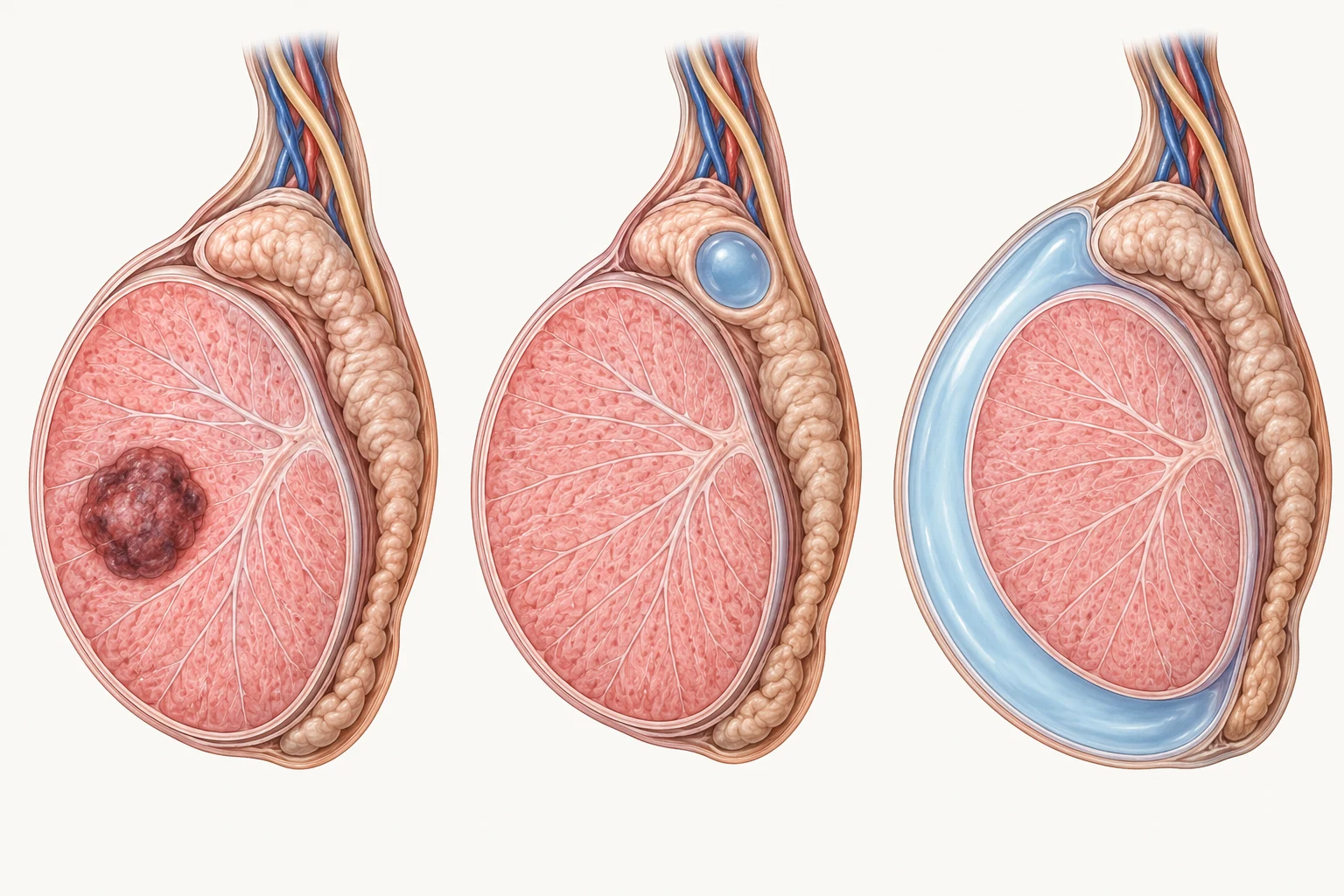
- Solid focus within the testis
- Testicular boundary
- Cyst arising outside the testis
- Separate, otherwise normal testis
- Hydrocele fluid around the testis
- Testis within the fluid sac
Intratesticular solid lump
Concerning for a testicular tumour. Use the urgent suspected cancer pathway when indicated; imaging must not delay an appropriate referral.
Epididymal cyst
A smooth extratesticular cyst with a separately palpable normal testis supports this diagnosis. Uncertain localisation needs further assessment.
Hydrocele
Fluid surrounds the testis and may transilluminate. If the testis cannot be adequately assessed, investigate rather than assume the swelling is benign.
Remember: A new non-painful change in testicular size, shape or texture warrants consideration of a suspected cancer referral. Unexplained or persistent testicular symptoms warrant urgent ultrasound. Acute severe pain needs immediate assessment for torsion; do not wait for a scan.
AI-generated anatomical teaching illustrations, not ultrasound images; simplified and not to scale. Sources: NICE NG12: testicular cancer · BAUS: epididymal cyst · BAUS: hydrocele · NHS: testicular lumps and pain
Testicular Torsion
Sudden onset severe pain, nausea, high-riding testis, absent cremasteric reflex.
Surgical Emergency. Refer to A&E/Urology immediately (4-6 hour window to save testis). Do not wait for ultrasound.
Testicular Cancer
Painless (or dull ache), hard, irregular lump. Does not transilluminate. 2-Week Wait Referral. Young men (20-40s).
Epididymo-orchitis
Gradual onset pain, swollen/tender epididymis, fever. Often STI (chlamydia/gonorrhoea) in <35s (Treat: Ceftriaxone + Doxycycline) or Enteric (E.coli) in >35s (Treat: Ofloxacin/Ciprofloxacin).
Hydrocele
Smooth, fluctuant, transilluminates. Check testis can be felt underlying.
8Urinary Incontinence (Women)
Differentiate Stress vs Urge incontinence.
Stress Incontinence
Leakage on exertion (cough/sneeze).
Treatment: Pelvic Floor Muscle Training (PFMT) - supervised, at least 3 months. Duloxetine is second line.
Urge Incontinence (Overactive Bladder)
Sudden compelling desire to pass urine.
Treatment: Bladder retraining (at least 6 weeks). Anticholinergics (Oxybutynin/Tolterodine) or Mirabegron. Caution with anticholinergics in the elderly (dementia risk).
Red Flags
Cauda equina signs, haematuria, recurrent UTI, pelvic mass.
9Renal Colic and Stones
Sudden onset, severe "loin to groin" pain. Patient is restless (cannot get comfortable).
Visual explanation
Renal colic: identify the patient who cannot wait
Suspected ureteric stone: assess observations, infection, urine output, renal function and pain control.
Infection / sepsis + obstruction
An infected obstructed urinary system is a urological emergency. Arrange emergency hospital assessment.
↳ Antibiotics and urgent drainage may be needed; antibiotics alone may be insufficient.
Anuria or uncontrolled symptoms
Anuria, deteriorating renal function, a solitary kidney or refractory pain/vomiting needs urgent hospital / urological assessment.
Stable suspected renal colic
Provide appropriate analgesia and arrange urgent imaging through the local pathway. Do not assume a stone from pain or dipstick alone.
Remember: Deterioration, fever/rigors or reduced urine output should trigger reassessment. Consider alternative diagnoses, including vascular and pregnancy-related causes where relevant.
Simplified teaching diagram. Sources: EAU: obstructed kidney and sepsis · NICE NG118: renal stones
Acute Management
- Analgesia: NSAIDs (e.g., IM Diclofenac or PR Voltarol) are superior to opioids for colic pain.
- Admission: Fever/sepsis, solitary kidney, anuria, unable to manage pain.
Conservative Management
Most stones <5mm pass spontaneously. Sieve urine. Increase fluids. Safety net for infection.
Prevention
Hydration. Thiazide diuretics (for calcium stones). Allopurinol (for uric acid stones).
10Erectile Dysfunction
Defined as the inability to attain or maintain an erection sufficient for sexual performance.
Etiology
Often vascular (ED is a predictor of coronary artery disease - the "canary in the coal mine"). Also neurological, hormonal (low testosterone), or psychogenic.
Assessment
Check BP, HbA1c, Lipids, Testosterone (9am fasting). Review medication (beta-blockers, antidepressants).
Management
- Lifestyle: Weight loss, stop smoking, exercise.
- PDE-5 Inhibitors (Sildenafil/Tadalafil). Contraindicated if taking nitrates (risk of severe hypotension).
- Ensure patient understands sexual stimulation is still required for the drug to work.
Practice with AI Actors
5 relevant roleplay cases
Apply what you've learned about Renal and Urology in a realistic, voice-driven consultation. Speak with the AI Actor as you would a real patient and get instant feedback.


