

Women's Health
Contraception, menstrual problems, menopause, pregnancy-related issues and gynaecological concerns.
Last reviewed
Use this quick reference guide to study and ensure you have mastered these common cases from the curriculum. You can generate specific cases on our SCA cases page or even practice them with our specialised and UK guidelines trained AI Actors.
Table of Contents
1Menopause and HRT
Menopause is a clinical diagnosis in women >45 with menopausal symptoms and no periods for 12 months (or 24 months if <50). FSH is not required for diagnosis in this group.
Lifestyle Management
Diet, exercise, weight loss, caffeine/alcohol reduction.
HRT (Systemic)
- • Sequential: If periods present/irregular (still perimenopausal).
- • Continuous: If post-menopausal (>1 year no periods).
No Uterus: Oestrogen only.
Route: Transdermal (patch/gel) preferred if BMI >30, risk of VTE, or history of migraine.
Genitourinary Syndrome of Menopause (GSM)
Vaginal Oestrogen (cream/pessary/ring). Safe to use alongside systemic HRT and generally safe in breast cancer history (with specialist advice).
Risks
Small increased risk of breast cancer (combined HRT) and VTE (oral HRT).

2Heavy Menstrual Bleeding (Menorrhagia)
Defined as excessive blood loss interfering with physical, emotional, social, and material quality of life.
Assessment
- History: Flooding, clots, double protection, impact on life. Check for anaemia symptoms.
- Examination: Abdominal and pelvic exam (speculum + bimanual) to exclude fibroids/polyps.
Management (if no pathology/fibroids <3cm)
- Levonorgestrel Intrauterine System (LNG-IUS e.g., Mirena): First-line treatment. Reduces bleeding significantly.
- Non-hormonal: Tranexamic Acid (1g TDS during bleeding) +/- Mefenamic Acid (500mg TDS for pain).
- Hormonal: Combined Oral Contraceptive Pill (COCP) or Cyclical Oral Progestogens.
Referral
If fibroids >3cm, compression symptoms, or medical management fails.
3Contraception: UKMEC and Missed Pills
Use the UK Medical Eligibility Criteria (UKMEC) to determine safety.
UKMEC Categories
- 1: No restriction.
- 2: Advantages outweigh risks.
- 3: Risks outweigh advantages (specialist/clinical judgement required).
- 4: Unacceptable health risk (Contraindicated).
Key Contraindications (UKMEC 3/4 for COCP)
Migraine with aura, BMI ≥35, Breastfeeding <6 weeks postpartum, uncontrolled hypertension, history of VTE/Stroke, age >35 and smoker (>15/day).
Missed Pills (Combined)
- 1 pill: Take as soon as remembered. No extra protection needed.
- 2+ pills (active): Take most recent pill, leave others. Use condoms for 7 days. If in week 1 (and unprotected sex occurred) → Emergency Contraception. If in week 3 → Omit pill-free interval (run packs together).

4Endometriosis and Chronic Pelvic Pain
Chronic condition where endometrial-like tissue grows outside the uterus.
Visual explanation
Endometriosis: tissue outside the uterus
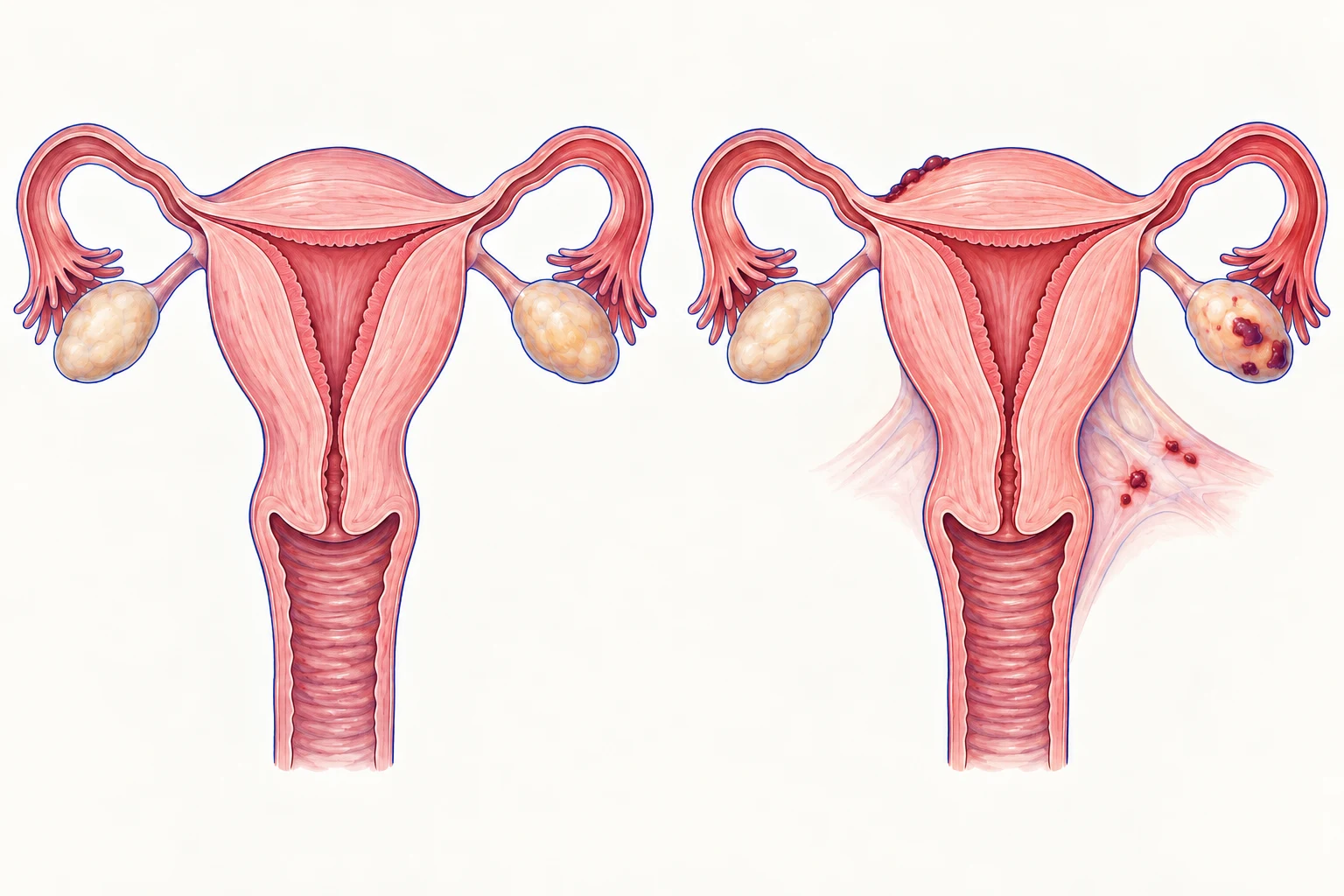
Endometrium
The lining is normally inside the uterine cavity.
Endometriosis
Tissue similar to the lining grows outside the uterus, including on pelvic surfaces and ovaries.
Remember: The location helps explain pelvic pain and possible bowel or bladder symptoms. A normal ultrasound does not exclude endometriosis.
Simplified illustration, not to scale. Sources: NHS: endometriosis · NICE NG73: diagnosis
Symptoms
Cyclical pelvic pain, deep dyspareunia (pain on deep penetration), dysmenorrhoea, dyschezia (pain on opening bowels).
Investigation
Transvaginal Ultrasound (TVUS). Note: A normal scan does not exclude endometriosis.
Management
- Analgesia: Paracetamol/NSAIDs.
- Hormonal (Suppress ovulation): COCP (tricycled/continuous), POP, or Mirena IUS.
- Referral: If symptoms persist despite primary care management, or if deep endometriosis/endometrioma suspected. Gold standard diagnosis is Laparoscopy.
5Cervical Screening and HPV
The programme invites women aged 25-64.
Protocol
High-Risk HPV (hrHPV) is the primary test.
- hrHPV Negative: Return to routine recall (3 years if 25-49, 5 years if 50-64).
- hrHPV Positive + Cytology Normal: Repeat test in 12 months.
- hrHPV Positive + Cytology Abnormal (Dyskaryosis): Refer for Colposcopy.
Red Flags
Post-coital bleeding (PCB), intermenstrual bleeding (IMB), or persistent vaginal discharge require speculum examination. Suspect Cervical Cancer even with normal smear history.
6Polycystic Ovary Syndrome (PCOS) and Amenorrhoea
Common cause of oligomenorrhoea/amenorrhoea and subfertility.
Rotterdam Criteria (2 out of 3)
- • Oligo/Anovulation (irregular/infrequent periods).
- • Hyperandrogenism (clinical: hirsutism/acne OR biochemical: raised testosterone/FAI).
- • Polycystic ovaries on ultrasound.
Management
- Endometrial Protection: Women with amenorrhoea/oligomenorrhoea (<4 periods a year) are at risk of Endometrial Hyperplasia. Induce a withdrawal bleed at least every 3-4 months using COCP or cyclical progestogens (e.g., Medroxyprogesterone 10mg x 14 days). Mirena IUS is also protective.
- Metabolic: Screen for Diabetes (HbA1c) and CVD risk. Weight loss is first-line.
7Pelvic Inflammatory Disease (PID)
Infection of the upper genital tract, usually sexually transmitted (Chlamydia/Gonorrhoea) but can be non-STI.
Features
Bilateral pelvic pain, deep dyspareunia, abnormal discharge, PCB/IMB.
Examination
Cervical motion tenderness ("cervical excitation") and adnexal tenderness.
Treatment
Low threshold for antibiotic treatment to prevent fertility/tubal damage.
- Regimen: IM Ceftriaxone (stat) + Doxycycline (14 days) + Metronidazole (14 days).
- Partner notification and STI screening essential.
8Urinary Incontinence and Prolapse
Differentiate between Stress and Urge incontinence.
Visual explanation
Stress and urge leakage: two different mechanisms
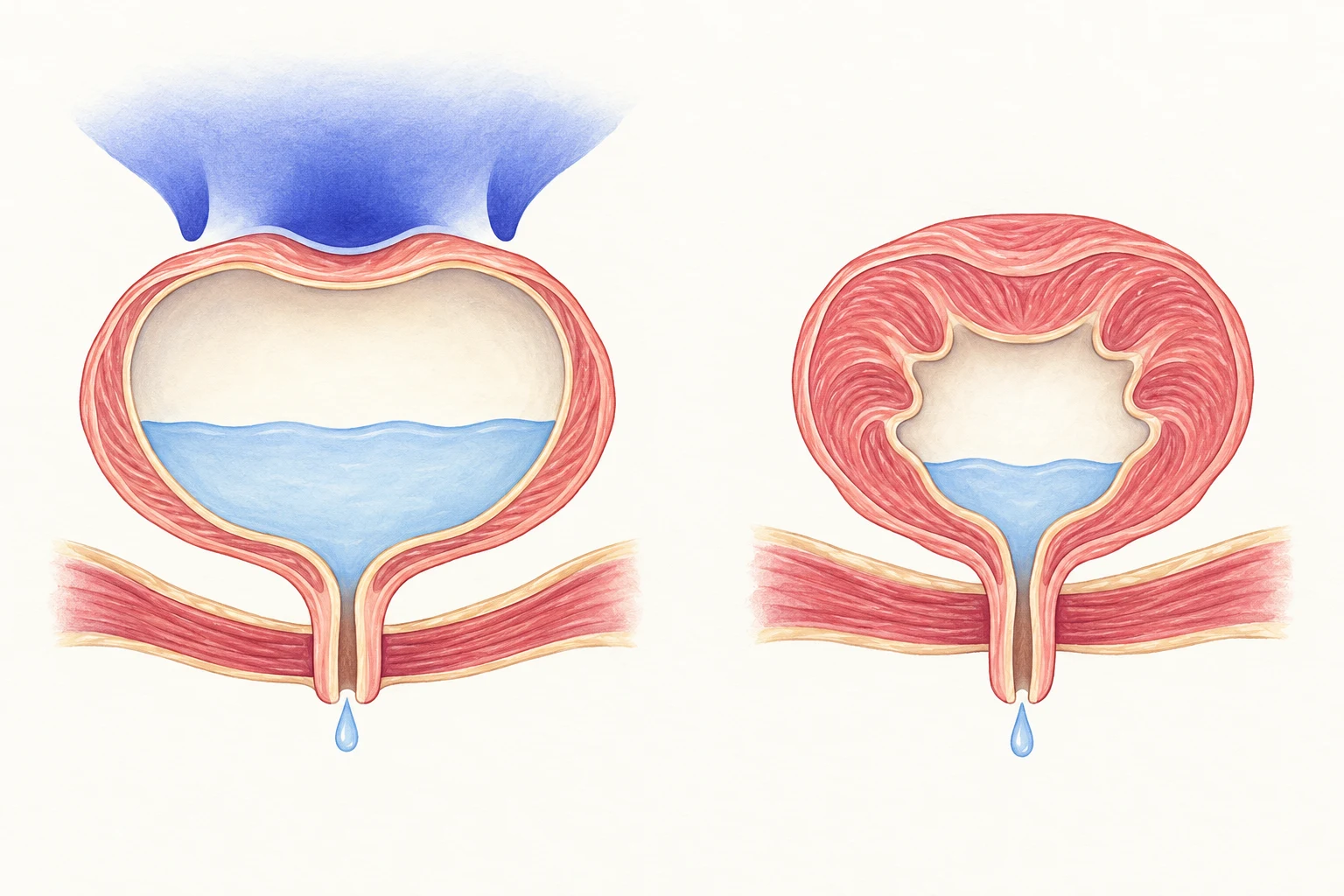
Stress incontinence
Pressure from coughing, sneezing or exertion overcomes the ability of the urethra to stay closed.
Urge incontinence
Leakage follows a sudden, compelling need to pass urine; involuntary bladder muscle contraction is a common mechanism.
Remember: Stress here means physical pressure. Ask what happens just before the leakage. Stress and urge symptoms can occur together as mixed incontinence.
Simplified illustration, not to scale. Sources: NHS: causes of urinary incontinence
Stress Incontinence
Leakage on effort/exertion (cough, sneeze, jump).
Management: Pelvic Floor Muscle Training (PFMT) - supervised for 3 months. Duloxetine is second-line (specialist initiation usually).
Urge Incontinence (Overactive Bladder)
Sudden compelling desire to pass urine.
Management: Bladder training (drills) for 6 weeks. Caffeine reduction. Anticholinergics (e.g., Oxybutynin, Tolterodine) or Beta-3 agonists (Mirabegron). Caution with anticholinergics in elderly (cognitive burden).
Prolapse
"Dragging" sensation, lump at introitus. Manage with PFMT, weight loss, topical oestrogen (if atrophy), pessaries, or surgery.
9Gynaecological Cancers: Red Flags
Crucial 2-Week Wait (2WW) referral criteria.
Ovarian Cancer
Persistent bloating, early satiety, pelvic pain, urinary urgency/frequency (especially >50). Measure CA125. If raised → Ultrasound → 2WW.
Endometrial Cancer
Post-menopausal bleeding (PMB) is the cardinal red flag. Refer all PMB >55 years on 2WW. (Also consider if <55 with risk factors/persistent irregular bleeding).
Cervical Cancer
Unexplained cervical mass or ulceration.
Vulval Cancer
Unexplained vulval lump or ulceration.
10Breast Disorders: Benign vs Malignant
Most presentations are benign, but cancer must be excluded.
2-Week Wait Referral
- • Aged >30 with unexplained breast lump (painful or painless).
- • Aged >50 with unilateral nipple changes (discharge, retraction).
- • Skin changes (peau d'orange, tethering).
- • Axillary lump >30.
Benign Conditions
- Fibroadenoma: "Breast mouse", mobile, firm, smooth. Common in younger women (<30).
- Cysts: Smooth, fluid-filled.
- Mastalgia (Breast Pain): Cyclical vs Non-cyclical. Usually managed conservatively (well-fitting bra, topical NSAIDs). Alone, rarely cancer.
Practice with AI Actors
5 relevant roleplay cases
Apply what you've learned about Women's Health in a realistic, voice-driven consultation. Speak with the AI Actor as you would a real patient and get instant feedback.


