

Child Health
Paediatric presentations, developmental concerns, childhood illnesses and immunisation.
Last reviewed
Use this quick reference guide to study and ensure you have mastered these common cases from the curriculum. You can generate specific cases on our SCA cases page or even practice them with our specialised and UK guidelines trained AI Actors.
Table of Contents
1The Febrile Child & Sepsis Risk Stratification
Fever is a very common presentation. The key is to differentiate self-limiting viral illness from serious bacterial infection using the NICE Traffic Light System.

🟢 Green (Low Risk)
Normal colour, responds to social cues, content/smiles, stays awake/awakens quickly, strong normal cry/not crying, moist mucous membranes.
🟡 Amber (Intermediate Risk)
Pallor reported by parent, not responding normally to social cues, no smile, wakes only with prolonged stimulation, decreased activity, poor feeding, reduced urine output, temperature ≥39°C (age 3-6 months), fever ≥5 days, rigors, swelling of a limb or joint, non-weight bearing.
🔴 Red (High Risk)
Pale/mottled/ashen/blue skin, lips or tongue, no response to social cues, appears ill to a healthcare professional, does not wake or if roused does not stay awake, weak, high-pitched or continuous cry, grunting, tachypnoea (>60 breaths/min), moderate/severe chest indrawing, reduced skin turgor, bulging fontanelle, neck stiffness, focal neurological signs, focal seizures, status epilepticus, non-blanching rash, temperature ≥38°C (age <3 months).
Management
- Green: Manage at home with safety netting.
- Amber: Safety net or refer to paediatric assessment unit depending on clinical judgement.
- Red: Urgent referral to paediatrics/ED.
Sepsis
Always think "Could this be sepsis?". Look for tachycardia, tachypnoea, low oxygen saturation, altered mental state, or a non-blanching rash.

2Respiratory Distress: Bronchiolitis
Viral lower respiratory tract infection, usually caused by RSV. Most common in children <2 years, peaking in winter.
Diagnosis
Coryzal prodrome (1-3 days) followed by persistent cough, tachypnoea, chest recession, and/or wheeze/crackles. Symptoms usually peak days 3-5.
Red Flags for Admission (Refer Immediately)
- • Apnoea (observed or reported).
- • Persistent O2 saturation <92% (or <90% if aged >6 weeks).
- • Inadequate oral fluid intake (50-75% of usual volume).
- • Severe respiratory distress (grunting, marked chest recession, RR >70).
Management
- Supportive care: Do not use bronchodilators (salbutamol), steroids, or antibiotics. They are ineffective.
- Safety Net: Advise parents on signs of deterioration (work of breathing, fluid intake, wet nappies) and when to seek help.
3Childhood Asthma: Diagnosis and Management
Asthma diagnosis in children is clinical, based on symptoms (wheeze, breathlessness, chest tightness, cough) that are variable and worse with triggers (viral infection, exercise, allergen).
Diagnosis
- High Probability: Trial of treatment (SABA + ICS).
- Intermediate Probability: Watchful waiting or trial of treatment.
- Low Probability: Consider alternative diagnosis.
Testing: FeNO and Spirometry (if aged >5 and able to perform).
Management Steps (Aged 5-16)
- SABA (Salbutamol) as needed.
- Add low-dose ICS (Inhaled Corticosteroid) as maintenance.
- Add LTRA (Montelukast).
- Add LABA (Long-Acting Beta Agonist).
Preschool Wheeze (<5 years)
Distinguish "viral-induced wheeze" (only with colds) from "multiple trigger wheeze" (with colds + exercise/allergens).
- Viral Wheeze: Treat with SABA. Consider Montelukast or ICS if frequent/severe.
- Multiple Trigger: Trial of ICS.
4Croup (Laryngotracheobronchitis)
Viral upper airway infection causing airway oedema. Typically ages 6 months to 3 years.
Visual explanation
Croup and bronchiolitis affect different airway levels
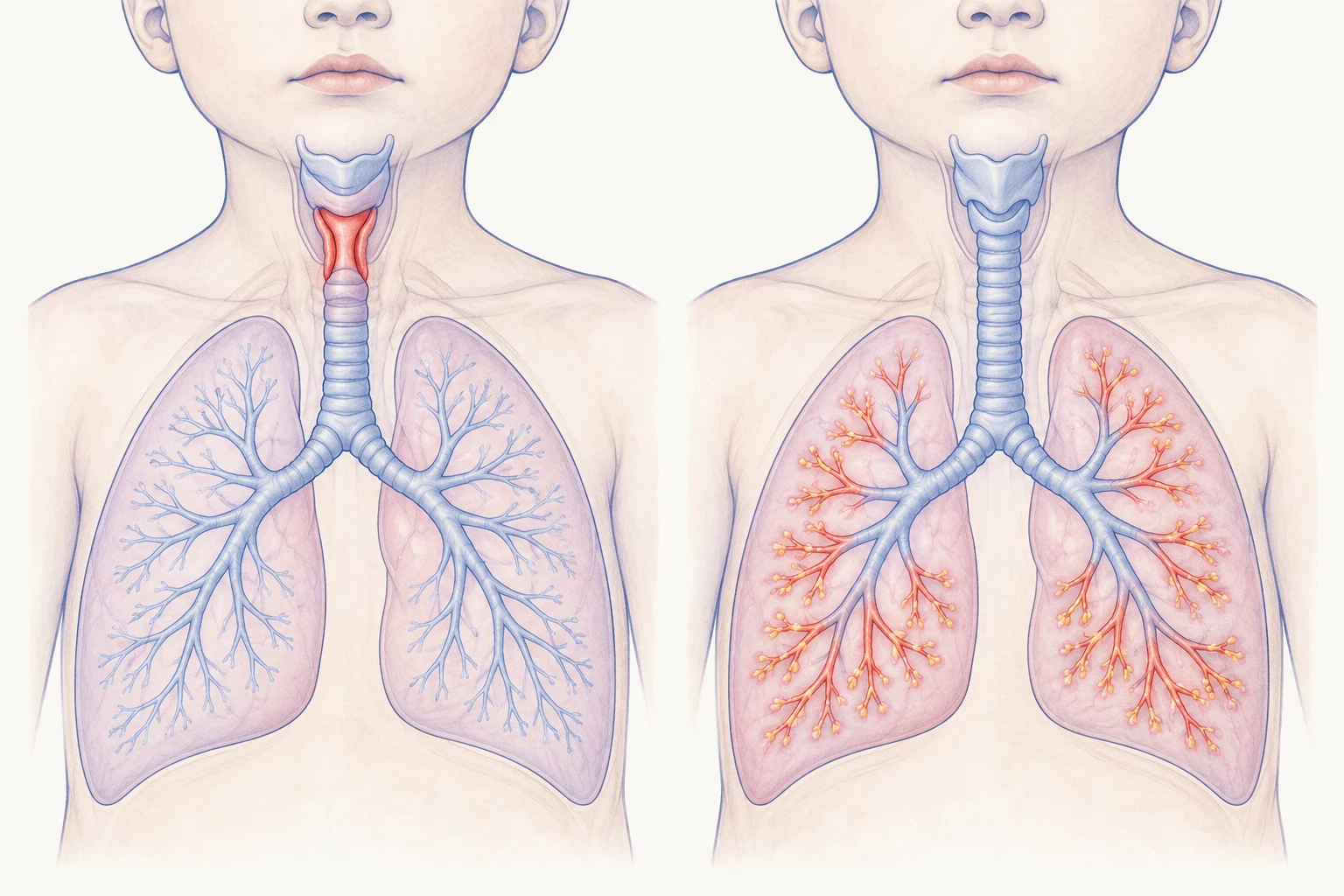
Croup: upper airway
Subglottic swelling: barking cough, hoarse voice and inspiratory stridor.
Bronchiolitis: small airways
Inflamed bronchioles: cough, wheeze or crackles, and increased work of breathing.
Remember: Use the location to explain the different sounds. Assess breathing effort, feeding and overall condition as well as the sound itself.
Simplified illustration, not to scale. Sources: NHS: croup · NHS: bronchiolitis
Features
Barking ("seal-like") cough, hoarse voice, stridor, worse at night.
Assessment (Severity)
- Mild: Barking cough but no stridor at rest, no recession.
- Moderate: Stridor at rest, some recession, child agitated.
- Severe: Significant stridor at rest, marked recession, agitation/lethargy (signs of hypoxia).
Management
- Single dose oral Dexamethasone (0.15 mg/kg): For ALL severities (including mild).
- Admission: Moderate/Severe croup, or mild croup with risk factors (age <6 months, history of upper airway abnormalities).
- Emergency: Nebulised adrenaline (in hospital).
5Urinary Tract Infections (UTI)
Symptoms can be non-specific in young children (fever, vomiting, lethargy, poor feeding).
Urine Collection
Clean catch is best. Use urine collection pads if necessary.
Dipstick Interpretation
- <3 months: Refer to paediatrics urgently (do not rely on dipstick).
- 3 months - 3 years: Send urine for microscopy and culture. Start antibiotics if specific urinary symptoms or clinically unwell.
- >3 years: Dipstick can guide treatment. Nitrites + Leukocytes = Treat. Nitrites alone = Treat. Leukocytes alone = Send culture, only treat if specific symptoms.
Treatment (Lower UTI)
Trimethoprim or Nitrofurantoin for 3 days.
Referral for Imaging
Required for atypical UTI (seriously ill, poor urine flow, abdominal mass, raised creatinine, septicaemia, non-E. coli organism) or recurrent UTIs.
6Constipation in Children
Very common functional problem. Don't miss organic causes (Hirschsprung's - delayed meconium, ribbon stools; Hypothyroidism).
Visual explanation
The pain–withholding cycle in childhood constipation
1
Painful stool
Passing a hard stool hurts and can make the child anxious.
2
Withholding
The child tries to avoid another painful bowel movement.
3
Stool stays longer
More water is absorbed while stool remains in the bowel.
4
Harder, larger stool
The next bowel movement is more difficult and painful.
Back to painful stool: the cycle can repeat.
Remember: Overflow soiling can happen when softer stool leaks around retained hard stool. It is involuntary. Explain this without blame and agree a treatment and follow-up plan.
Simplified teaching diagram. Sources: NICE CG99: childhood constipation · NHS: soiling in children
Diagnosis
<3 stools per week, hard/large stools ("rabbit droppings" or blocking toilet), overflow soiling, retentive posturing.
Management
- Disimpaction: If faecal impaction is present (overflow soiling/mass), use escalating doses of Macrogol (e.g., Movicol/Laxido) over 1-2 weeks.
- Maintenance: Macrogol is first-line. Add stimulant (Senna) if needed.
- Education: Diet, fluids, toileting routine (sit on toilet after meals). Do NOT rely on diet alone to treat established constipation.
7Faltering Growth and Cows' Milk Protein Allergy (CMPA)
Faltering Growth
Drop across 2 major centile spaces on growth chart. Assess intake, output, and psychosocial environment.
CMPA
Immune reaction to milk protein.
- IgE-mediated (Immediate): Skin (hives, angioedema), Respiratory (wheeze), GI (vomiting) within minutes. Risk of anaphylaxis.
- Non-IgE-mediated (Delayed): Skin (eczema), GI (reflux, loose stools, blood in stool, colic/constipation) hours/days later.
Management (Non-IgE)
- Breastfed: Maternal dairy exclusion diet (with calcium/Vit D supps) for 2-4 weeks. Reintroduce to confirm.
- Formula-fed: Extensive Hydrolysed Formula (eHF) e.g., Nutramigen/Aptamil Pepti for 2-4 weeks. Amino Acid Formula (AAF) e.g., Neocate if severe.

8Child Safeguarding: Recognition and Action
GPs have a statutory duty to safeguard children.
Categories of Abuse
Physical, Emotional, Sexual, Neglect.
Red Flags (Physical)
- • Bruising in non-mobile babies ("Those who don't cruise, rarely bruise").
- • Bruising in protected areas (ears, neck, cheeks, buttocks, inner thighs).
- • Defensive injuries (forearms).
- • Patterned bruising (hand prints, implements).
- • Burns (cigarette, immersion scalds with clear tide lines).
- • Delayed presentation or explanation inconsistent with injury/developmental stage.
Action
If you suspect abuse, you must refer to Children's Social Care. Consult local safeguarding lead. Document meticulously (body maps, verbatim quotes).
9The Limping Child
Common presentation. Differentiate trauma/infection from transient causes.
Differential Diagnosis by Age
- Toddler (1-3): Septic arthritis, Transient synovitis ("Irritable hip"), Toddler's fracture (spiral tibial fracture), Developmental Dysplasia of the Hip (DDH).
- Child (4-10): Perthes disease (avascular necrosis of femoral head), Transient synovitis, Septic arthritis.
- Adolescent (11-16): Slipped Upper Femoral Epiphysis (SUFE), Osgood-Schlatter disease, Septic arthritis.
Red Flags (Septic Arthritis)
"Kocher's Criteria": Non-weight bearing, Fever >38.5, ESR >40/CRP >20, WBC >12.
Emergency Orthopaedic Referral.
Transient Synovitis
Diagnosis of exclusion. Well child, afebrile, recent viral illness. Resolves with rest/NSAIDs.
SUFE
Obese adolescent male with hip/knee pain and limp. External rotation on hip flexion. Urgent Orthopaedic Referral.
10Developmental Milestones and Red Flags
Screening for developmental delay during routine checks or opportunistic consults.
Gross Motor
Red Flags: Not sitting unsupported by 9 months. Not walking by 18 months. Hand preference before 12 months (cerebral palsy).
Fine Motor/Vision
Red Flags: No visual fixation by 2 months. Not reaching for objects by 6 months. No pincer grip by 12 months.
Speech and Language
Red Flags: No babbling by 12 months. No single words by 18 months. No 2-word phrases by 2.5 years.
Social/Emotional
Red Flags: No smile by 8 weeks. No eye contact. Lack of joint attention/pointing. (Consider Autism Spectrum Disorder).
Practice with AI Actors
8 relevant roleplay cases
Apply what you've learned about Child Health in a realistic, voice-driven consultation. Speak with the AI Actor as you would a real patient and get instant feedback.


