

Skin Disorders (with pictures)
Dermatology essentials including rashes, skin cancer, eczema, psoriasis and skin infections.
Last reviewed
Use this quick reference guide to study and ensure you have mastered these common cases from the curriculum. You can generate specific cases on our SCA cases page or even practice them with our specialised and UK guidelines trained AI Actors.
Table of Contents
1Atopic Eczema: Diagnosis and Stepwise Management
Atopic eczema is a chronic, relapsing, inflammatory skin condition characterised by an itchy red rash and a faulty skin barrier.
Visual explanation
Deteriorating eczema: erosions versus golden crust
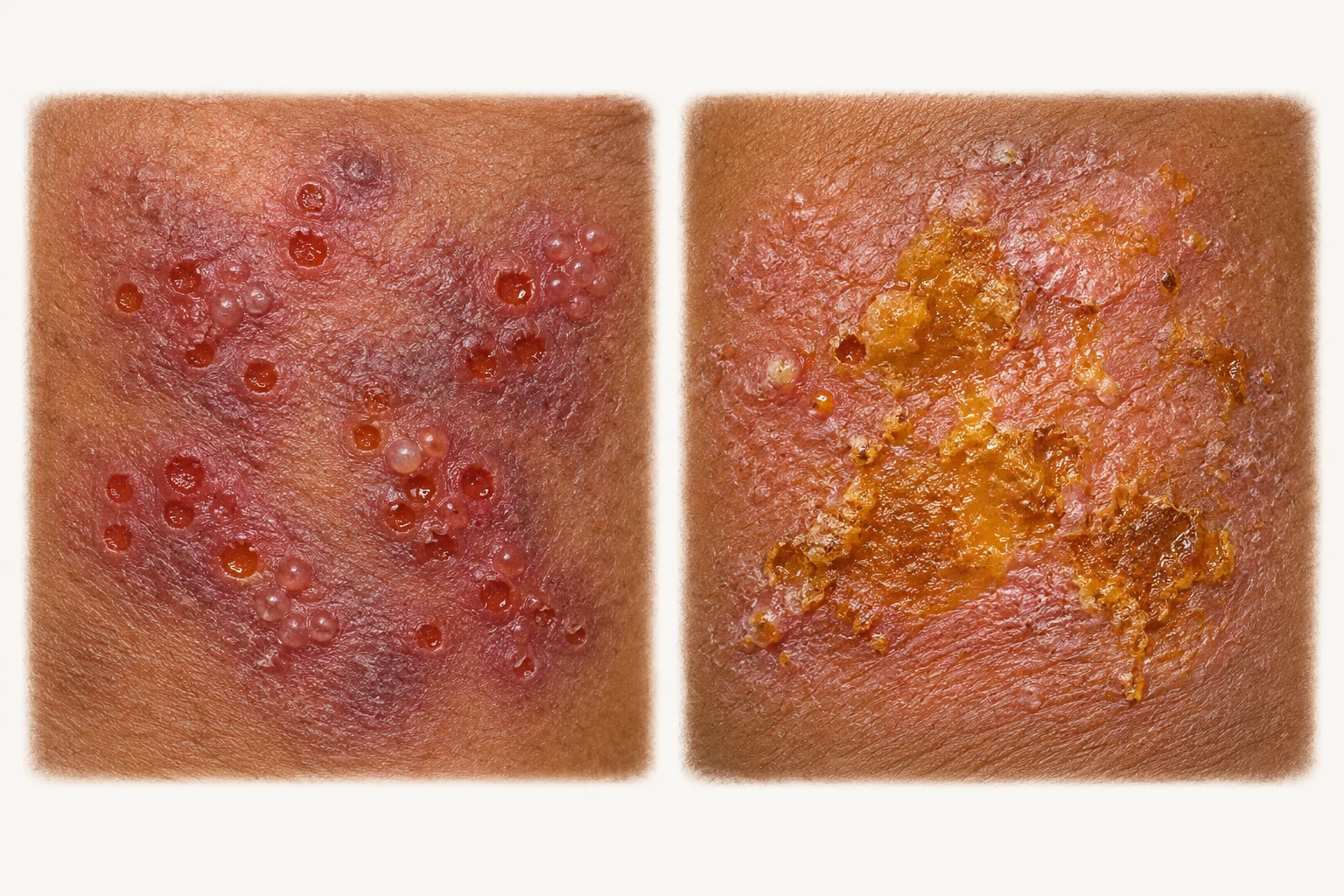
- Round, punched-out erosions
- Grouped vesicles
- Golden crusting and weeping
Eczema herpeticum example
Painful monomorphic vesicles or punched-out erosions, often spreading rapidly; fever or malaise may occur.
Bacterial infection example
Crusting, weeping and pustules can occur with bacterial infection. These signs also occur in flares, and herpes and bacteria can coexist.
Remember: Suspected eczema herpeticum needs immediate systemic antiviral treatment and same-day dermatology discussion. Periocular involvement also needs same-day ophthalmic advice. Do not rely on crust colour or skin redness alone.
AI-generated teaching illustrations, not patient photographs. Appearances vary; use the clinical context. Sources: PCDS: eczema herpeticum · NICE NG190: secondary bacterial infection of eczema
Diagnosis
Itchy skin plus 3 or more of:
- •Visible flexural dermatitis (or cheeks/extensors in infants)
- •History of flexural dermatitis
- •History of dry skin in the last year
- •History of asthma or allergic rhinitis (or in 1st-degree relative if <4 years)
- •Onset under the age of 2 years
Management - Stepwise Approach
Prescribe large quantities (e.g., 500g pumps) to be used liberally and frequently (at least twice daily) even when skin is clear. Ointments (e.g., 50:50, Hydromol) are best for very dry skin but creams (e.g., Cetraben, Zerobase) are cosmetically more acceptable. Avoid aqueous cream as a leave-on moisturiser (causes irritation).
Use the lowest potency necessary to control inflammation. Finger Tip Units (FTU) guide dosage.
- Mild: Hydrocortisone 1% (Face, neck, flexures)
- Moderate: Clobetasone butyrate (Eumovate)
- Potent: Betamethasone valerate (Betnovate), Mometasone (Elocon)
- Very Potent: Clobetasol propionate (Dermovate) – Specialist use or specific indications (e.g., thick plaques on palms/soles)
(e.g., Tacrolimus/Pimecrolimus). Useful for sensitive sites (face/eyelids) where steroids are risky. Usually initiated by a specialist or GP with extended role.

Infected Eczema
Signs: Weeping, crusting ("golden crust"), pustules, rapid worsening.
Treatment: If localized, topical antibiotic/steroid combination (e.g., Fusidic acid + Betamethasone) for max 2 weeks. If widespread, oral Flucloxacillin (or Clarithromycin) for 5-7 days.

2Acne Vulgaris: Treatment Pathways and Antibiotic Stewardship
Acne is a disorder of the pilosebaceous unit involving sebum, keratin, and Cutibacterium acnes.
Mild
Comedones (blackheads/whiteheads) + few papules
Moderate
Widespread papules/pustules + mild scarring
Severe
Nodules, cysts, significant scarring
Management Guidelines
- • Topical Retinoid (Adapalene) + Benzoyl Peroxide (e.g., Epiduo)
- • Topical Retinoid + Topical Antibiotic (e.g., Treclin - Clindamycin/Tretinoin)
- Choice: Lymecycline 408mg OD or Doxycycline 100mg OD
- Duration: Max 3 months. Review at 8-12 weeks. If effective, can continue to 6 months max, then stop and maintain with topical.
Antibiotic Stewardship Rules
- •Never use oral antibiotic monotherapy (always co-prescribe topical retinoid/benzoyl peroxide to prevent resistance)
- •Avoid macrolides (Erythromycin) unless tetracyclines contraindicated (high resistance rates)
- •Contraindications: Tetracyclines and Topical Retinoids are teratogenic. Avoid in pregnancy/breastfeeding.
3Psoriasis: Assessment and Management
A chronic autoimmune condition causing rapid skin cell turnover, resulting in well-defined red plaques with silvery scale.
Assessment
Assess severity using body surface area (BSA) or DLQI (Dermatology Life Quality Index). Screen for Psoriatic Arthritis (pain/swelling in joints, morning stiffness >30 mins).

Chronic Plaque Psoriasis
- First-line: Potent corticosteroid + Vitamin D analogue applied once daily (separately or in combination foam/gel e.g., Enstilar/Dovobet) for up to 4 weeks.
- Maintenance: Break from steroids. Use Vitamin D analogue alone (Calcipotriol) twice daily.
- Flexural/Facial: Mild/Moderate steroid only (Hydrocortisone/Eumovate). Vitamin D analogues can irritate these sites.
- Scalp Psoriasis: Potent steroid lotion/gel. Salicylic acid/tar preparations (e.g., Sebco) to lift thick scale (descale) before applying steroids.
Guttate Psoriasis
"Raindrop" lesions often triggered by Streptococcus infection. Often self-limiting (months). Treat with emollients +/- mild steroids or phototherapy if persistent.
Referral Criteria
- •Erythrodermic or Generalized Pustular Psoriasis (Emergency)
- •Extensive disease not controlled by topicals
- •Impact on work/life
4Skin Cancer: Recognition and 2-Week Wait Referral
Early detection is vital. Use the 2-Week Wait (2WW) pathway for suspected malignancy.
Visual explanation
Suspicious lesions: BCC and SCC surface clues
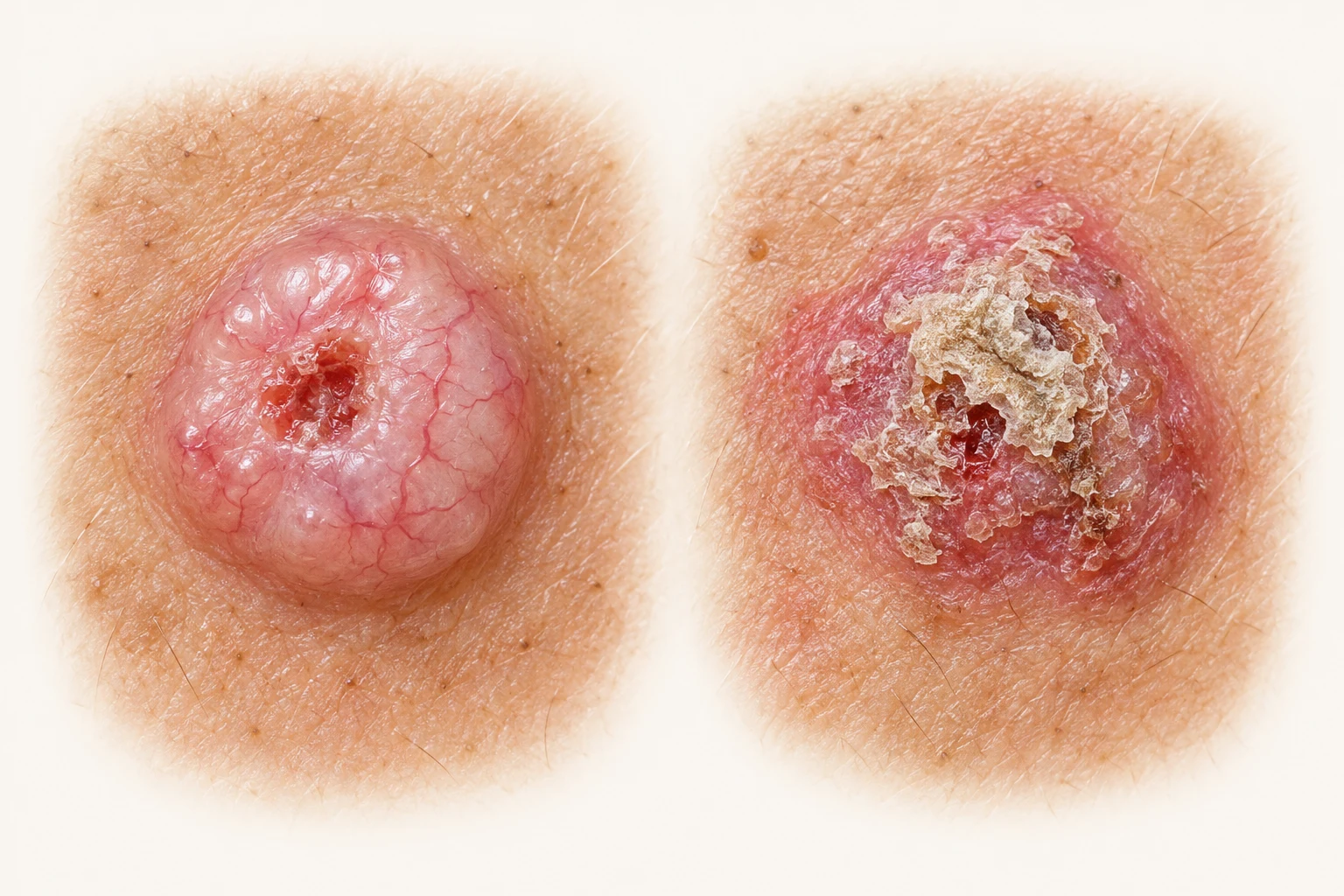
- Pearly, rolled lesion edge
- Fine surface telangiectasia
- Adherent central keratin / crust
Nodular BCC example
A shiny pearly nodule with surface vessels, rolled border and possible central ulceration.
SCC example
A keratotic or crusted, sometimes ulcerated lesion. Growth, tenderness and patient risk factors add to concern.
Remember: These clues cannot confirm histology or exclude melanoma. Suspected SCC needs a suspected cancer pathway referral. BCC referral urgency depends on factors such as site and size; use the local pathway.
AI-generated teaching illustrations, not patient photographs. Appearances vary; use the clinical context. Sources: BAD: skin cancer clinical features · NICE NG12: skin cancer referral

Malignant Melanoma - Weighted 7-Point Checklist
Refer if score ≥3:
Major features (2 points each):
- • Change in size
- • Irregular shape
- • Irregular colour
Minor features (1 point each):
- • Diameter ≥7mm
- • Inflammation
- • Oozing/Bleeding
- • Change in sensation
Dermoscopy: Refer if dermoscopy suggests melanoma.
Squamous Cell Carcinoma (SCC)
Features: Keratinising, crusty, ill-defined nodule, often ulcerated, grows rapidly over weeks/months. Tender.
Action: 2WW Referral
Basal Cell Carcinoma (BCC)
Features: Pearly nodule, rolled edge, telangiectasia, central ulceration (rodent ulcer). Grows slowly over months/years.
Action: Routine referral usually appropriate. Only 2WW if concern about site (e.g., eyelid/nose) or size/rapid growth.

5Rosacea: Subtypes and Management
Chronic inflammation of the facial skin. Distinguish from acne by the absence of comedones (blackheads).

Papulopustular
Papules and pustules on central face
Erythematotelangiectatic
Flushing, persistent redness, thread veins
Phymatous
Thickening of skin (e.g., Rhinophyma - bulbous nose)
Ocular
Gritty eyes, blepharitis
Management
- General: Daily high SPF sunscreen (UV triggers flares). Avoid triggers (spicy food, alcohol, heat).
- Papulopustular (Mild-Mod): Topical Ivermectin (Soolantra) or Azelaic Acid or Metronidazole gel.
- Papulopustular (Mod-Severe): Oral Doxycycline 40mg Modified Release (Efracea) or Lymecycline.
- Persistent Erythema: Mirvaso (Brimonidine) gel (vasoconstrictor) – warn about rebound redness.
- Ocular: Lid hygiene, lubricating drops, oral tetracyclines if severe.
6Bacterial Skin Infections: Impetigo and Cellulitis

Impetigo
Highly contagious superficial infection (Staph aureus/Strep pyogenes). Non-bullous: "Golden/honey-coloured crusts" around nose/mouth.
Treatment:
- • Localized: Hydrogen Peroxide 1% cream (Crystacide) is now first-line (to reduce antibiotic resistance). Topical Fusidic acid is second-line.
- • Widespread: Oral Flucloxacillin (or Clarithromycin) for 5 days.
School: Exclude until lesions crusted over or 48h after starting antibiotics.
Cellulitis
Infection of deep dermis/subcutaneous tissue. Features: Unilateral red, hot, swollen, painful limb. Systemic upset.
Management: Mark the edge of erythema to monitor spread.
Antibiotics: Flucloxacillin 500mg-1g QDS for 5-7 days. (Clarithromycin/Doxycycline if penicillin allergic).
Eron Classification - Admission Criteria
Admit if Class III (toxic/unstable) or Class IV (sepsis/necrotising fasciitis).
7Fungal Infections: Tinea and Onychomycosis

Tinea Corporis (Ringworm)
Annular plaque with central clearing and active scaly border.
Treatment: Topical Clotrimazole or Terbinafine cream.
Tinea Capitis (Scalp Ringworm)
Patchy hair loss, scaling, broken hairs. Common in children.
Treatment: Requires Oral antifungal (Griseofulvin/Terbinafine). Topical is ineffective. Refer to secondary care or specialist initiation often required for children.
Onychomycosis (Fungal Nail)
Diagnosis: Must confirm with nail clippings (microscopy & culture) before starting oral treatment as treatment is long and has side effects.
- Oral Treatment: Terbinafine (for dermatophytes) for 3 months (toes) / 6 weeks (fingers). Itraconazole pulse therapy is alternative.
- Topical: Amorolfine lacquer – only for mild distal disease (less effective).
8Infestations: Scabies and Head Lice

Scabies
Infestation by Sarcoptes scabiei. Symptoms: Intense itch (worse at night). Burrows (grey lines) in web spaces, wrists, genitals.
Treatment: Permethrin 5% cream.
- • Apply to whole body (neck down, but include head/neck in infants/elderly)
- • Apply to cool, dry skin. Leave on for 8-12 hours then wash off
- • Repeat treatment after 7 days
Crucial Points for Scabies
- •Treat ALL household contacts and sexual partners simultaneously, even if asymptomatic
- •Wash bedding/clothes at >50°C
- •Post-scabetic Itch: Itch can persist for 4-6 weeks after successful eradication. Treat with emollients/antihistamines.
Head Lice
Treatment: Dimeticone 4% lotion. Treat only if live lice found. Detection combing is gold standard.
9Alopecia: Differential Diagnosis and Management

Alopecia Areata
Autoimmune. Features: Discrete, smooth, round bald patches. "Exclamation mark" hairs at edges.
Management: Often spontaneous regrowth (50-80%). Potent topical steroids or intralesional steroids (specialist) can be tried. Refer if extensive (Totalis/Universalis).
Androgenetic Alopecia (Male/Female Pattern)
Features: Progressive thinning (temples/crown in men, central parting in women).
Management: Topical Minoxidil (available OTC). Oral Finasteride (men only, private prescription). Not NHS funded.
Telogen Effluvium
Features: Generalized shedding/thinning 3 months after a trigger (stress, illness, pregnancy, crash diet). Positive hair pull test.
Management: Reassurance. Reversible once trigger resolves.
Scarring Alopecia
(e.g., Lichen Planopilaris, Discoid Lupus). Redness, scaling, loss of follicular ostia. Urgent Referral to prevent permanent loss.
10Benign Skin Lesions: Seborrhoeic Keratoses, Cysts, and Lipomas
Confident recognition avoids unnecessary referrals.

Seborrhoeic Keratosis
Features: "Stuck-on" appearance, warty, greasy/waxy surface, pigmented (can be very dark). Variable size.
Management: Benign. Reassure. Removal only if catching/bleeding (usually private/minor surgery).
Epidermoid Cyst
Features: Firm, round nodule attached to skin. Central punctum (blackhead). Contains foul-smelling cheesy keratin.
Management: Excision if recurrently infected or bothersome. Do not incise and drain unless acutely abscessed (will recur as sac remains).
Lipoma
Features: Soft, mobile, subcutaneous lump (in fat layer, not skin). "Slippage sign" (slips away from finger).
Management: Reassure.
Dermatofibroma
Features: Firm, small nodule, often on legs (reaction to insect bite). "Dimple sign" (skin dimples inwards when lesion pinched).
Benign.
Practice with AI Actors
4 relevant roleplay cases
Apply what you've learned about Skin Disorders in a realistic, voice-driven consultation. Speak with the AI Actor as you would a real patient and get instant feedback.


Related Topics
Cardiology
Heart disease, hypertension, chest pain, arrhythmias, heart failure and cardiovascular risk assessment.
Respiratory
Asthma, COPD, pneumonia, breathlessness, cough and respiratory infections in primary care.
Gastroenterology
Abdominal pain, IBS, IBD, dyspepsia, liver disease and gastrointestinal red flags.