

Neurology
Essential neurology topics including headaches, seizures, stroke, and common neurological presentations in primary care.
Last reviewed
Use this quick reference guide to study and ensure you have mastered these common cases from the curriculum. You can generate specific cases on our SCA cases page or even practice them with our specialised and UK guidelines trained AI Actors.
Table of Contents
1Headache: Assessment and Red Flags
Headache is one of the most common neurological presentations. The GP's primary role is to differentiate between primary headaches (migraine, tension, cluster) and secondary headaches requiring urgent investigation.
Red Flags requiring urgent referral or admission:
- •Thunderclap headache: Sudden onset, reaching maximum intensity within 5 minutes (suspect subarachnoid haemorrhage).
- •Headache with systemic features: Fever, rash, neck stiffness (meningitis), weight loss, or history of malignancy.
- •New onset neurological deficit: Weakness, sensory loss, visual field defects.
- •Headache triggered by Valsalva: Coughing, sneezing, or exertion (raised ICP).
- •Postural headache: Worse on lying down or waking (raised ICP), or worse on standing (low pressure).
- •New onset in patients >50: Suspect Giant Cell Arteritis (GCA) or malignancy.
- •Papilloedema on fundoscopy.
Giant Cell Arteritis (Temporal Arteritis)
Suspect in patients >50 with new temporal headache, scalp tenderness, jaw claudication, or visual disturbance.
Action: Urgent inflammatory markers (ESR/CRP). If visual symptoms are present, same-day ophthalmology/emergency referral is required to prevent permanent blindness. Start high-dose steroids (prednisolone 40-60mg) immediately if suspicion is high, before biopsy.

2Migraine: Diagnosis and Management
Migraine is often underdiagnosed. Diagnosis is clinical based on the ICHD-3 criteria (unilateral, pulsating, moderate/severe intensity, aggravated by activity, plus nausea/vomiting or photophobia/phonophobia).
Acute Management
- First-line: Combination therapy of an oral triptan (e.g., Sumatriptan 50mg) + NSAID (e.g., Naproxen) or Paracetamol.
- Anti-emetics: Metoclopramide or prochlorperazine if nausea is significant.
- Timing: Take treatment as early as possible during the attack.
Prophylaxis
Consider if migraines impact quality of life or occur frequently (e.g., >4 days/month).
- First-line: Propranolol 80-160mg daily (avoid in asthma), Topiramate (teratogenic – highly restricted in women of childbearing potential), or Amitriptyline 25-75mg at night.
- Review: Trial for at least 3 months at an effective dose.
Medication Overuse Headache
Suspect if using triptans/opioids ≥10 days/month or simple analgesics ≥15 days/month. Management involves abrupt withdrawal of the overused medication.
Women's Health
- Combined Oral Contraceptive Pill (COCP): Contraindicated in migraine with aura due to increased stroke risk.
- HRT: Transdermal routes preferred in migraineurs.
3Transient Ischaemic Attack (TIA) and Stroke Prevention
A TIA is a medical emergency carrying a high risk of subsequent stroke. The ABCD2 score is no longer recommended for triage; all suspected TIAs require urgent assessment.
Suspected TIA Management
- Aspirin 300mg stat: Give immediately unless contraindicated or already taking long-term anticoagulation or bleeding disorder.
- Referral: Refer immediately to a specialist TIA clinic (to be seen within 24 hours). Do not wait for investigations.
- Driving: Must not drive for at least 1 month.
Secondary Prevention
- Antiplatelets: Clopidogrel 75mg daily is usually first-line long-term.
- Statins: High-intensity statin (Atorvastatin 80mg) should be started immediately if not contraindicated.
- Blood Pressure: Target <130/80 mmHg.
- Atrial Fibrillation: If detected, anticoagulation (DOAC or Warfarin) is indicated usually 2 weeks after the event.

4Epilepsy and Seizures
GPs manage chronic epilepsy, medication side effects, and initial presentation of seizures.
First Seizure
- Referral: Urgent referral to a First Seizure Clinic/Neurology (2-week pathway if suspected tumour).
- DVLA: Patient must stop driving immediately. For a first unprovoked seizure, typically 6 months off driving (if scans/EEG normal) or 12 months (if abnormalities found).
- Safety Advice: Showers not baths, avoid heights/heavy machinery, caution with cooking/swimming.
Established Epilepsy
- Medication Reviews: Check adherence and side effects.
- Valproate: Highly teratogenic. It must not be started in anyone under 55, male or female, unless two specialists independently agree and record that nothing else works or is tolerated, or that the reproductive risks do not apply. In women and girls who could become pregnant, use it only if other options are unsuitable and the Pregnancy Prevention Programme (PPP) is in place, with an annual specialist review. Advise men to use effective contraception (condoms, plus contraception for a female partner) during treatment and for 3 months after stopping. Patients should not stop valproate without specialist advice, because seizures may get worse.
- Contraception: Enzyme-inducing AEDs (e.g., Carbamazepine, Phenytoin) reduce the efficacy of hormonal contraception. Intrauterine methods (Copper IUD/Mirena) are preferred. Lamotrigine levels can be lowered by the COCP.
Emergency: Status Epilepticus
Seizure >5 minutes or repeated seizures without recovery. Community management: Buccal midazolam or rectal diazepam. Call 999.
5Parkinson's Disease and Tremor
Parkinson's is a progressive neurodegenerative condition characterised by the triad of bradykinesia, rigidity, and resting tremor.
Clinical Features (TRAP)
- Tremor: 'Pill-rolling', resting tremor (4-6Hz), usually asymmetric.
- Rigidity: 'Lead-pipe' or 'Cogwheel'.
- Akinesia/Bradykinesia: Slow movement, shuffling gait, reduced arm swing, micrographia (small handwriting).
- Postural instability: Late feature.
Differential Diagnosis
- Essential Tremor: Symmetrical, postural/action tremor (worse with movement, better with rest/alcohol). Treat with Propranolol or Primidone.
- Drug-induced: Antipsychotics, anti-emetics (metoclopramide).
Management
- Referral: Refer untreated patients to neurology/geriatrics specialist (do not start medication in primary care prior to diagnosis).
- Medications: Levodopa (co-careldopa/co-beneldopa), Dopamine Agonists (risk of impulse control disorders – gambling, hypersexuality), MAO-B inhibitors (e.g. Selegiline).
- DVLA: Must inform DVLA.
6Dementia and Cognitive Impairment
Early diagnosis allows for planning and access to support.
Visual explanation
Memory concerns: build a picture before a diagnosis
1
Hear the story
Explore onset, progression and daily function. With consent, include someone who knows the person well.
2
Assess cognition and health
Use a validated cognitive test and a physical examination. Consider hearing, vision and communication needs.
3
Look for other contributors
Review medicines, mood and appropriate investigations for potentially reversible causes.
4
Agree the next steps
If dementia remains suspected, refer to a specialist diagnostic service and offer support while waiting.
Remember: No single test diagnoses dementia, and a normal cognitive score does not exclude it. Sudden confusion needs urgent assessment.
Simplified teaching diagram. Sources: NHS: tests for diagnosing dementia · NICE NG97: initial assessment and referral
Assessment
- History: Collateral history from family is essential. Onset, progression, impact on ADLs.
- Cognitive Testing: 6CIT, GPCOG, or MMSE.
- Blood Screen ("The Confusion Screen"): FBC, U&Es, LFTs, Calcium, Glucose, TFTs, B12/Folate to rule out reversible causes.
Subtypes
Alzheimer's: Insidious onset, short-term memory loss prominent.
Vascular: Step-wise progression, history of vascular risk factors/stroke.
Lewy Body: Fluctuating cognition, visual hallucinations, parkinsonism.
Frontotemporal: Personality change, disinhibition, language difficulty, early onset.
Management
- Referral: Refer to Memory Clinic for diagnosis.
- Medication: Acetylcholinesterase inhibitors (Donepezil, Galantamine, Rivastigmine) for Alzheimer's/Lewy Body. Memantine for moderate/severe.
- Support: Power of Attorney, driving advice (must inform DVLA), carer support.
7Multiple Sclerosis and Demyelination
MS is an inflammatory condition of the CNS, typically affecting young adults (F>M).
Visual explanation
Myelin: insulation that helps nerve signals travel
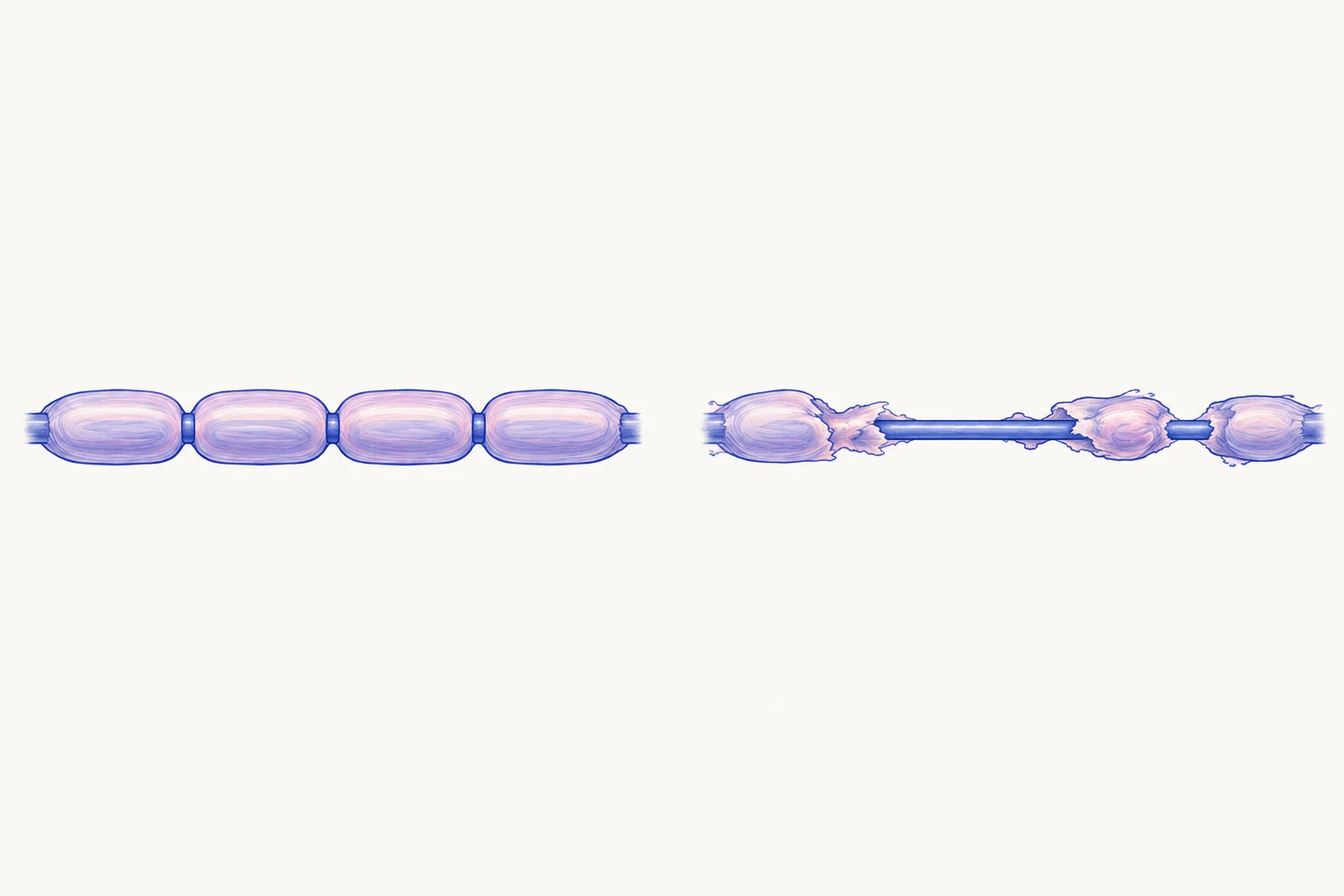
- Myelin sheath
- Node of Ranvier
- Exposed axon after myelin loss
Intact myelin
An insulating sheath surrounds the axon, with small gaps between segments.
Demyelination
Damage to the sheath can slow or block the passage of nerve signals.
Remember: In MS, inflammation affects the brain and spinal cord. Different sites of damage help explain the variety of symptoms, including visual, sensory, movement or balance problems.
Simplified illustration, not to scale. Sources: WHO: multiple sclerosis and myelin · NHS: multiple sclerosis
Presentations
- Optic Neuritis: Painful unilateral visual loss, washed-out colour vision.
- Sensory: Paraesthesia, numbness, Lhermitte's sign (electric shock sensation on neck flexion).
- Motor: Weakness, spasticity.
- Cerebellar: Ataxia, tremor, dysarthria.
- Autonomic: Urinary urgency/retention, erectile dysfunction.
Referral
Refer to neurology if MS is suspected. MRI is the diagnostic modality of choice. Do not diagnose on MRI alone.
Primary Care Management
- Relapses: Discuss with specialist. Methylprednisolone 0.5g daily for 5 days may shorten relapse duration but doesn't alter prognosis.
- Symptom control: Baclofen/Gabapentin for spasticity; Anticholinergics for bladder; Sildenafil for ED.
- Infections: UTIs can mimic relapses (pseudo-relapse). Always check urine.
8Dizziness and Vertigo
Distinguish true vertigo (illusion of movement/spinning) from light-headedness (presyncope) or disequilibrium.
Common Peripheral Causes
- Benign Paroxysmal Positional Vertigo (BPPV): Short episodes (<1 min) triggered by head movement. Diagnosis: Dix-Hallpike manoeuvre (positive = nystagmus). Treatment: Epley manoeuvre.
- Vestibular Neuritis: Acute severe vertigo, nausea, vomiting, no hearing loss. History of viral illness.
- Labyrinthitis: As above + hearing loss/tinnitus.
- Meniere's Disease: Triad of vertigo (hours), tinnitus, and sensorineural hearing loss + aural fullness.
Central Causes (Red Flags)
Vertical nystagmus, persistent severe vertigo, focal neurological signs (dysarthria, ataxia, weakness). Suspect posterior circulation stroke or tumour. Urgent referral/admission.
9Peripheral Neuropathy and Neuralgia
Peripheral Neuropathy
- Presentation: "Glove and stocking" distribution numbness, paraesthesia, or pain.
- Common Causes: Diabetes (most common), Alcohol excess, Vitamin B12 deficiency, Chronic Kidney Disease, Hypothyroidism, Drugs (chemotherapy).
- Investigations: HbA1c, U&Es, LFTs, TFTs, B12/Folate, ESR/CRP, Serum Electrophoresis (myeloma).
Neuropathic Pain/Neuralgia
- Trigeminal Neuralgia: Intense, shooting, electric-shock face pain. Triggered by touch/chewing. First-line: Carbamazepine.
- Post-herpetic Neuralgia: Pain persisting after Shingles.
- Management: Amitriptyline, Duloxetine, Gabapentin, or Pregabalin. (Be aware of abuse potential with gabapentinoids).
10Serious Spinal Pathology: Cauda Equina Syndrome
A surgical emergency caused by compression of the cauda equina nerve roots. Missed diagnosis can lead to permanent paralysis and incontinence.
Red Flags (The 5 'S's)
- Saddle anaesthesia: Loss of sensation in the perineum, buttocks, inner thighs.
- Sphincter disturbance: Urinary retention (most common/sensitive) or incontinence; faecal incontinence or loss of anal tone.
- Sexual dysfunction: Erectile dysfunction, loss of sensation.
- Severe pain: Back pain + bilateral sciatica.
- Skeletal/Motor: Bilateral leg weakness or foot drop.
Action
- • Immediate emergency admission for urgent MRI spine and neurosurgical decompression.
- • Do not wait for primary care physio or imaging.
- • Safety net all patients with back pain regarding these specific symptoms.
Practice with AI Actors
4 relevant roleplay cases
Apply what you've learned about Neurology in a realistic, voice-driven consultation. Speak with the AI Actor as you would a real patient and get instant feedback.


Related Topics
Cardiology
Heart disease, hypertension, chest pain, arrhythmias, heart failure and cardiovascular risk assessment.
Respiratory
Asthma, COPD, pneumonia, breathlessness, cough and respiratory infections in primary care.
Gastroenterology
Abdominal pain, IBS, IBD, dyspepsia, liver disease and gastrointestinal red flags.